Welcome to Five in Focus, HMC Architects’ blog series spotlighting the trends, ideas, and innovations shaping the future of architecture and design. Each edition features insights from our leaders as they share what inspires them and what informs their work.
Amanda Hoehn is an interior design leader at Bassetti Architects, now a studio of HMC Architects. For the past twenty years, she has designed inspiring interiors throughout the Pacific Northwest, delivering functional spaces that complement the architecture and meet budget and schedule goals. In this Five in Focus, Amanda shares her thoughts on the challenges of hardworking PreK-12 spaces, mass timber construction, and insights from her own career path.

1. Interior Design is More Than Just Pretty Colors
Pretty colors and beautiful finishes are part of interior design, but the work goes much deeper. Interior designers study how people actually use space. A building can be stunning, but if it doesn’t function for daily life, you’ll hear about it quickly. In a PreK-12 environment, this is magnified. When 1,800 students and teachers move through a building every day, functionality isn’t optional—it’s critical.
Engaging with an interior designer early in the process allows the team to evaluate how furniture, storage, traffic flow, and gathering spaces will really perform. Are spaces sized appropriately? Will they flex the way the program intends? Does the layout support the reality of daily movement? Architects and interior designers collaborate to create a shared vision and then design spaces that support it. And it’s not just about students and teachers—it’s about the custodial staff who maintain the building every day.
Interior designers ask practical questions that may seem simple, but can fundamentally shape how successful a space becomes:
- Where do the tables go when this space is cleaned twice a day?
- If 32 students need to wash their hands in under five minutes, can we separate sinks to improve flow?
- If the district’s standard furniture is heavy and difficult to move, is “flexible space” truly achievable, or do we need to rethink the layout?
Throughout a project, I make it a priority to get to know teachers and administrators, and I observe how they move through their classrooms and the building. You can learn a tremendous amount just by watching. The end result is a more coordinated interior, one that supports learning, socializing, teaching, and maintenance, while still celebrating the architecture.
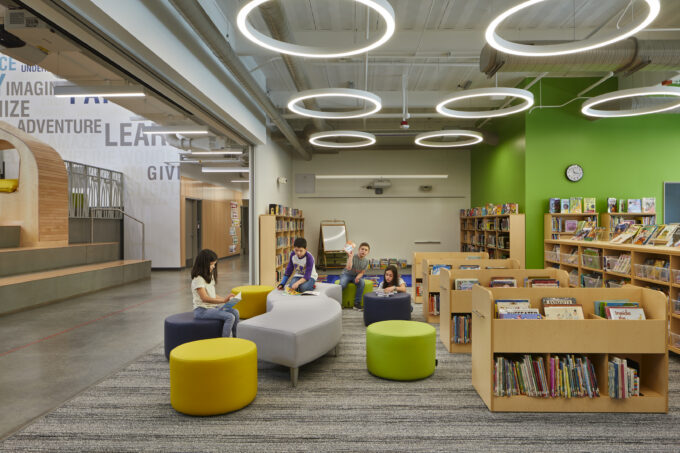
Truman Elementary School, Vancouver, Washington
2. 2026 is the Year We Fight for Wall Protection
Kids are tough on schools, especially those wily middle schoolers. I’ve stood in plenty of hallways during passing periods and observed: roughhousing, sliding along the walls, parkouring off anything within reach, and how they touch every possible surface. Wall protection isn’t a luxury—it’s essential to the longevity of our buildings. Products like MDF, plastic laminate-faced panels, FRL panels, and other durable systems are designed to take a beating and still look good for years. Yet on many projects, I see these solutions get value-engineered out. And I get it, budgets are tight. But at what long-term cost?
When wall protection is cut, facilities and maintenance teams are left patching, painting, and repairing over and over again just to keep the building presentable. Over time, it becomes harder to keep up. There isn’t enough manpower. There aren’t enough maintenance dollars. And the building slowly shows it. Students and staff deserve schools that look beautiful and function well for years to come. Wall protection plays a much bigger role in that than people realize. So, in 2026, I’m making it my mission to fight for it!
3. Mass Timber Schools are Beautiful…What? I Can’t Hear You!
Mass timber buildings are undeniably beautiful with exposed wood ceilings, columns, and beams that create a natural aesthetic. What more could an interior designer ask for? But then reality sets in with significant acoustical challenges. Wood does not absorb sound well, and in a lively school environment, strong acoustic performance is essential and often required by code.
As a project manager and interior designer specializing in mass timber buildings, I’ve seen how much of that beautiful wood we sometimes need to cover to baffle sound and create spaces that truly support learning. It’s a critical conversation to have at the very beginning of a project because it directly influences design decisions and carries cost implications.
When I began my career, there were only a limited number of materials that could be acoustic solutions. Today, we can select from an expanded set of solutions, each affecting the visual experience of a space—how much exposed wood will remain visible and how much area will teachers have for pin-up? Should ceiling treatments complement the wood or intentionally contrast with it? How will conduit, lighting, and fire sprinklers influence the acoustic layout? The questions are endless.
Early conversations, collaborative teamwork, and consistent coordination are essential to allowing teachers to speak comfortably and ensuring students can clearly hear instruction. In mass timber schools, beauty and performance must work hand in hand.
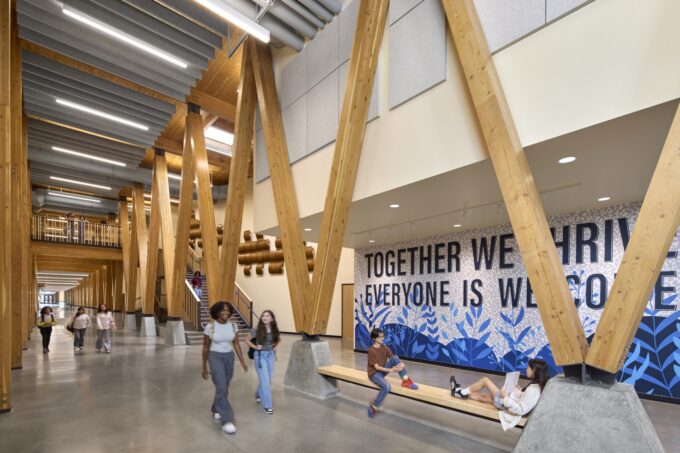
Mercer Middle School, Seattle, Washington
4. Interior Designer Living in a Project Manager World
Forward progress in your career is not always a straight line, even though it may be human nature to want a clearly outlined step-by-step instruction on how to get from point A to point B. My career is an example of making your own path forward.
To advance to where you want to go, you have to want to move up and put in the effort to show you are ready. But along with that, there also has to be a need and an opportunity within the company. This is where it can get sticky. In my case, my desire to be in a leadership role led me, by necessity, down a winding path into project management.
Back in 2018, I asked how an interior designer could move into a leadership role, and the answers were unclear, because that was not a common path. It was noted that working with clients and understanding the business side would be important. So I asked, “Is there a need for a project manager so I can learn?” And the answer was yes!
Training as a project manager (PM) was rocky at first—I was in over my head. But with patience and guidance from my mentors, I learned the ropes. I was able to get a lot of face time with clients and understand the nuances of deadlines, staffing, fees, and other critical factors that drive our projects’ success.
There are actually skills from interior design that have benefited my role as a PM. Interior designers typically work on multiple projects and deadlines simultaneously. Also, interior designers are typically social butterflies, good at navigating a variety of personalities, which is definitely a key skill in project management.
This gave me a strong foundation, but I had a lot to learn. Through hard work, lessons learned, mountains of new knowledge, and some failures, I was becoming a good PM and moving toward a leadership role. Today, in addition to being an interior design leader, I continue to serve as a PM.
A former principal once told me I was a “rock pusher,” explaining that in any organization, there are people who jump over obstacles, and others who look for creative ways around obstacles or rocks. Both of these types are essential, he explained. But then there are the rock pushers, the ones who dig in and move the obstacle out of the way to clear the path for people behind them. He explained that every company needs rock pushers. So whether it is in your own career or another challenge, don’t be afraid to dig in and push that rock!
5. Put the Phone Down—the Power (and Necessity) of Unplugging
Being a working parent is a constant balancing act. I am passionate and dedicated to the career I’ve built, but now there’s a tiny human who wants and deserves my undivided attention. After an hour-long commute home, I get about sixty minutes with my kiddo before bedtime. I’ve had to intentionally reprogram my brain to remember that work messages, social media, and Amazon orders can all wait. In that hour, my husband and I are scrambling to get dinner on the table, chasing a wild toddler, and navigating his online classes. It’s pure chaos, but it is the kind of chaos I know I’ll look back on one day with gratitude.
Are we exhausted? Yes.
Are we perfect at staying off our phones? No.
Will the world or our jobs fall apart if we unplug for an hour? Absolutely not.
It sounds simple, but in a world that never stops buzzing and a career that is not 9-5, I have to remind myself daily that it is okay to unplug and prioritize family. In K-12 educational design, we want to create amazing environments for our children to learn and grow—this actually starts at home. That hour is precious. It’s foundational. It’s where bonding and childhood happen. It is worth protecting.