By Michael Davis, AIA
Principal-in-Charge
One of the most powerful lessons in designing career and technical education (CTE) facilities is deceptively simple: when schools are deeply connected to industry, students thrive. When programs are shaped by real employers, real workforce needs, and real professional expectations, CTE becomes more than a class—it becomes a viable and transformative pathway.
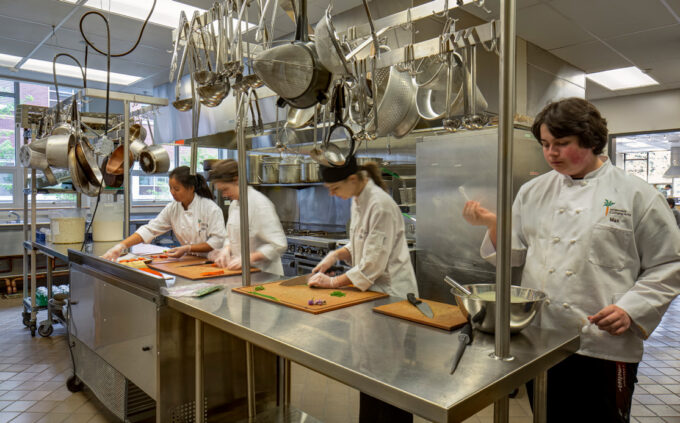
Early in my career, I witnessed this firsthand at Shorewood High School, just north of Seattle, where I worked closely with two exceptional educators. One led a culinary arts program that operated as a professional restaurant. Students wore chef uniforms, learned plating and service, catered community events, and prepared meals using produce they grew themselves.
Another instructor blended automotive technology, robotics, and fabrication into a hands-on engineering environment. These were not simulated exercises; they were authentic, industry-informed experiences that treated students as emerging professionals.
These programs succeeded because they were grounded in the realities of the workplace. The instructors brought industry experience, understood professional expectations, and cultivated relationships with community partners. Their classrooms mirrored the environments students would eventually enter. That alignment—education informed by industry—is what makes CTE effective.
FROM BACK LOT TO CENTER STAGE
Historically, vocational programs were often relegated to the margins of the campus. Auto shops and wood shops were pushed to the edges, physically and culturally separating students from the academic core. This isolation reinforced stereotypes and constrained opportunity.
Today’s most successful CTE programs reverse that model. They are integrated, visible, and connected.
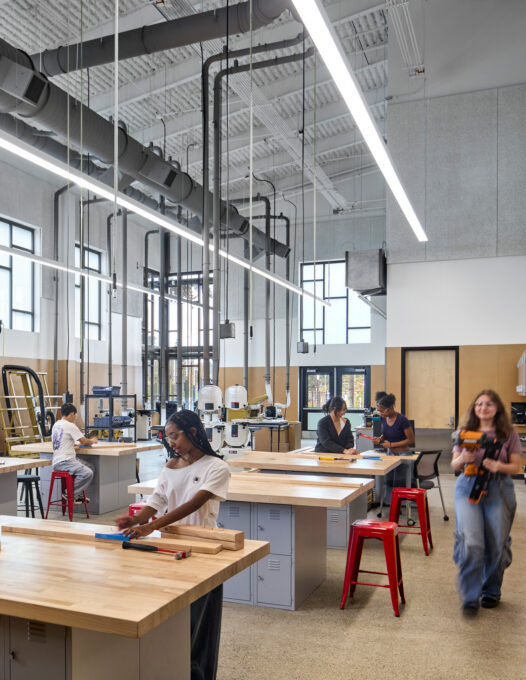
At schools such as Roosevelt High School in Portland and Evergreen High School in Seattle, CTE programs were embedded within learning communities rather than hidden away. Glass walls revealed fabrication spaces. Culinary labs and shops were positioned adjacent to central commons. Learning was made visible.
That visibility matters. When students see peers designing, building, cooking, coding, and creating, it reshapes perceptions of learning. CTE becomes aspirational rather than remedial. And when these spaces are designed with direct input from industry partners, they remain relevant as workforce needs evolve.
LEARNING FROM INDUSTRY, NOT GUESSING
One of the most common missteps in CTE planning is designing programs in isolation. When educators and designers attempt to predict workforce needs five or ten years out without industry guidance, programs inevitably lag. Industry partners remove this guesswork. They clarify which equipment matters, identify emerging technologies, and articulate real workforce gaps. When these voices are present at the planning table, both facilities and curricula reflect reality.
West Sound Technical Skills Center (West Sound Tech) in Bremerton, Washington, offers a compelling example. Recently completed by Bassetti Architects, A Design Studio of HMC Architects, the modernization and expansion of the campus serve students ages sixteen to twenty-one from more than a dozen districts across western Puget Sound. Programs span welding, automotive technology and collision repair, construction, criminal justice, fire science, cosmetology, esthetics, 3D animation, medical careers, maritime studies, and the planned return of HVAC training.
West Sound Tech provides hands-on, workforce-aligned education at no tuition cost. Many students travel hours each day to attend—clear evidence of the program’s value.
From the outset, industry partners helped define what success would look like. Welding programs align with shipyard, sheet metal, aluminum, and construction trades. Automotive facilities mirror commercial shops. Culinary programs operate as working restaurants. Healthcare spaces reflect clinical environments.
The result is a comprehensive workforce pipeline. Graduates move directly into shipyards, construction firms, repair shops, and medical facilities, while others pursue apprenticeships, advanced training, or higher education. Employers trust the programs because they helped shape them—and that trust is invaluable.
LEADERSHIP THAT BUILDS BRIDGES
Strong partnerships do not happen by accident; they require intentional leadership. At West Sound Tech, former director Shaney Watkins exemplified this approach by relentlessly cultivating relationships with employers. She established advisory boards, organized highly successful “Try a Trade” days, hosted mock interviews, and brought professionals into classrooms while sending students into real workplaces. Industry partners were treated as collaborators, not sponsors.
These efforts reshaped the school’s culture. Students gained not only technical skills but also professionalism, communication abilities, and a clear understanding of workplace expectations. The programs also helped dismantle stereotypes. Automotive and welding programs enrolled many young women, while healthcare and construction attracted diverse student populations. CTE became a space defined by opportunity rather than limitation.
AVIATION AS A MODEL FOR INTEGRATION
Few fields demonstrate the power of industry-aligned education more clearly than aviation in the Seattle region—one of the nation’s largest aerospace hubs.
At Raisbeck Aviation High School (RAHS), all learning is framed through aviation and aerospace. This public, STEM-focused school serves approximately four hundred students in grades nine through twelve from across Puget Sound. Core academics are integrated with aviation-related electives, including aerospace engineering, robotics, and aviation business. Physics becomes aerodynamics. Mathematics becomes navigation. Engineering becomes aircraft design.
Students build solar cars, test wings in wind tunnels, and work with mentors from major aerospace and aviation organizations. The relevance of their education is never abstract—it is visible every day.
In the Central Kitsap School District, aviation pathways begin as early as sixth grade. Middle school students use flight simulators, while high school students explore air traffic control, drone operations, and manufacturing processes. Some graduate with Federal Aviation Administration certifications and move directly into aerospace careers.
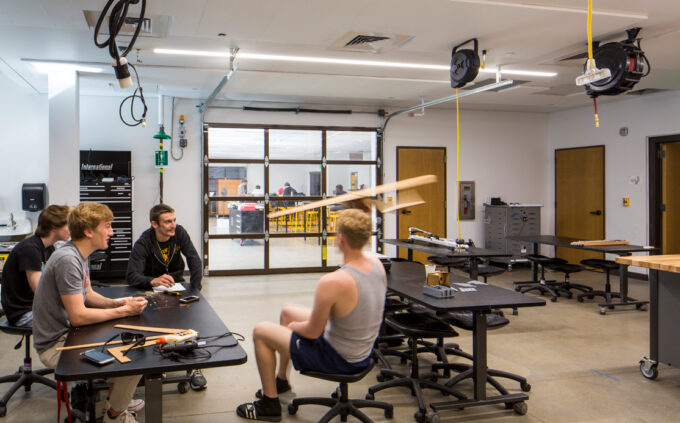
At Fairview Middle School, students engage in immersive, mission-based learning environments that apply science, technology, engineering, and mathematics in real-world contexts. Industry partnerships shape equipment selection, provide mentorship, and create feedback loops that keep programs current. This is alignment in practice.
HUMAN-CENTERED SKILLS IN AN AI-DRIVEN ECONOMY
The economy is undergoing a profound transformation as artificial intelligence reshapes administrative, financial, and analytical work. Many traditional office roles will be automated or redefined. Yet skilled trades, technical manufacturing, healthcare support, construction, and maintenance remain fundamentally human endeavors—and demand for these roles continues to grow.
AI cannot weld ship hulls, repair aircraft engines, install HVAC systems, or build homes. These jobs require judgment, dexterity, and adaptability. At the same time, the United States faces acute shortages in nearly every technical field.
For decades, students were encouraged to view success solely through the lens of four-year degrees, while technical careers were undervalued. Training pipelines weakened, apprenticeships declined, and recruitment faltered.
The consequences are now evident in labor shortages, delayed projects, rising costs, and strained communities. When aligned with industry, CTE is one of the most effective tools available to reverse this trend.
THINKING BEYOND SCHOOL WALLS
Despite the success of existing programs, access remains a challenge. Many students travel long distances to attend skills centers, while family responsibilities, transportation costs, or work schedules constrain others. Adults seeking retraining often lack flexible options. If workforce development is truly a priority, the scale and structure of CTE must expand.
What if CTE programs were embedded in community centers? What if evening and weekend training were commonplace? What if parents and students learned side by side?
Imagine a shared community hub where children attend after-school programs while parents train in HVAC, aviation maintenance, or medical assisting in the same facility. Such models could remove barriers, support working families, and transform underutilized buildings into engines of opportunity.
CTE AS A SOURCE OF COMMUNITY RESILIENCE
When career and technical education is aligned with industry, its impact extends far beyond the classroom. Students gain marketable skills. Families gain financial stability.
Employers gain reliable pipelines of trained workers. Communities become more resilient and economically sustainable. Graduates avoid crushing debt as they enter the workforce with dignity and long-term growth potential.
CTE also expands our understanding of intelligence and success. Creativity, craftsmanship, problem-solving, and perseverance are as valuable as test scores. Many students who struggle in traditional academic environments thrive when given hands-on challenges—a welding torch, a design project, a professional kitchen, or a flight simulator—because these settings honor how they learn best.
As technology reshapes work and inequality continues to challenge communities, CTE offers a practical and powerful source of hope. When grounded in strong industry partnerships, it connects learning to life, transforms education into opportunity, and builds sustainable futures—one skill, one partnership, and one student at a time.