By Steve Wilkerson, AIA
Principal-in-Charge
After more than three decades working with school districts across California, I have walked through—and helped design—hundreds of classrooms. Education has evolved in many ways during that time, but few changes have been as powerful or as encouraging as the growth of career and technical education (CTE). When done well, CTE transforms how students experience school. It turns passive learners into active participants, builds confidence and motivation, and helps students rediscover pride in their work. Most importantly, it allows many students to fall in love with learning again.
A major driver of this transformation has been the rise of industry partnerships. Many early CTE programs began as grassroots efforts, often led by a single dedicated teacher or a district seeking to improve enrollment and engagement. At first, these programs might have consisted of a single computer lab or repurposed classroom. Once authentic industry connections were formed, however, everything changed. Students could see why they were learning particular skills and how those skills translated directly to real careers.
Strong CTE programs, I have learned, are not simply about job training. They are about relevance, engagement, and providing students with a clear sense of purpose.
LEARNING THAT FEELS MEANINGFUL
Many traditional classrooms still rely heavily on lectures, worksheets, and standardized assignments. For some students, this approach is practical. For many others, it is not. I have heard countless students ask, implicitly or explicitly, “Why am I learning this?” When coursework feels abstract or disconnected from daily life, motivation can quickly erode. CTE fundamentally changes that dynamic.
In contemporary CTE classrooms, students edit videos, diagnose engines, prepare meals, construct buildings, secure networks, and operate production studios. They solve real problems using professional tools. In these environments, the relevance of learning is immediately apparent.
That sense of purpose makes a measurable difference. District partners consistently report higher engagement, improved attendance, and increased student participation in CTE pathways. As relevance rises, so does confidence.
FROM OBSERVERS TO CREATORS
One of CTE’s most powerful attributes is its ability to shift students from observers to creators. Rather than passively receiving information, students apply it. Instead of memorizing concepts, they put them to work. Collaboration replaces isolation.
CTE classrooms are active, dynamic environments. Students move between workstations, exchange ideas, troubleshoot challenges, and refine their work. There is no “back row” where students can disengage unnoticed.
Instructors function as coaches and mentors, circulating through the space to support individuals and small groups. Learning becomes personal and responsive. Over time, even students who were once reluctant to speak or present often begin to take on leadership roles. Many develop confidence as communicators and collaborators. CTE creates the conditions for these transformations to occur.
DESIGNING SPACES WITH INSPIRATION BUILT IN
The physical environment plays a critical role in CTE success. These spaces are fundamentally different from traditional classrooms. They must feel industry standard, accommodate specialized equipment, and support significantly greater power and infrastructure demands.
Well-designed CTE facilities communicate their purpose immediately. When students enter these environments, they sense that the work happening there matters. The spaces feel serious, professional, and authentic—places where honest work is expected and respected. That message alone can elevate motivation and engagement.
SAN JACINTO AND THE POWER OF MEDIA
One project that continues to resonate with me is the video production studio designed for the San Jacinto Unified School District. Though modest in budget, the project’s impact has been substantial.
The district sought to create a space where students could learn broadcasting, production, and media communication using professional tools.
The result was Tiger Media Network (TMN), a fully operational broadcast studio serving both the school and the broader community. Students produce daily broadcasts and manage every aspect of production, from camera operation and lighting to sound, editing, and on-air presentation.
At a ribbon-cutting held after the studio had been in use, a quiet student approached me and said, “Thank you. I didn’t know I had these opportunities before.” That moment captured the essence of CTE.
At San Jacinto, students do not merely study media—they become media professionals. Their work is shared publicly, fostering pride, ownership, and accountability. Many arrive early, stay late, and treat the studio as their own. That level of engagement is rare in traditional classroom settings.
SANTA ANA AND INDUSTRY-DRIVEN PATHWAYS
In the Santa Ana Unified School District, recent designs for four major CTE projects demonstrate the power of community-driven and industry-informed development. These programs emerged organically, shaped by dedicated educators, engaged students, and strong local industries.
Culinary and Hospitality. What began in cramped, improvised spaces evolved into a robust program supported by growing enrollment and industry partnerships. Purpose-built facilities now provide commercial teaching kitchens and instructional areas that mirror professional hospitality environments, strengthening realism and motivation.
Automotive Technology. Long a community resource, Santa Ana’s automotive program required modernization to meet contemporary demands. New facilities incorporate digital diagnostics, advanced electronics, and electric-vehicle infrastructure, ensuring students train on equipment aligned with today’s industry standards.
Digital Media Arts. Rapid growth outpaced the original lab space, prompting the creation of a proper studio environment designed for instruction and industry collaboration. Features such as a large roll-up door allow professionals to work alongside students. The space can also be rented during non-school hours, generating potential revenue for the district.
One instructor noted that a former student now earns more through a YouTube channel developed from class projects than she does as a teacher—a powerful example of entrepreneurial potential and independence fostered through CTE.
Building Construction Trades. Closely tied to Santa Ana’s local economy, this pathway benefits from active involvement by contractors, business owners, local trade unions, and alumni. Students work on real projects, gaining credibility, confidence, and a tangible connection to their community.
BUILDING CONFIDENCE AND BELONGING IN MORENO VALLEY
The most profound impact of CTE is personal. Students who feel invisible in traditional academic settings often find a sense of belonging in CTE programs.
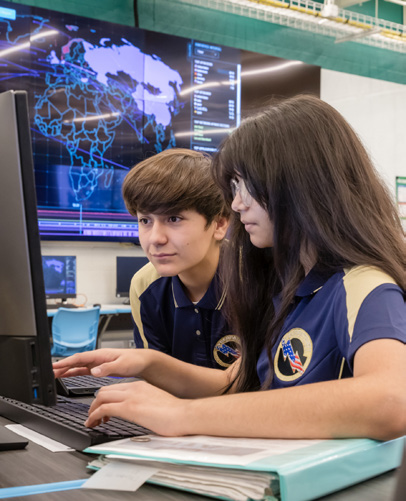
At Canyon Springs High School in the Moreno Valley Unified School District, a cyber innovation center opened in 2022 within repurposed shop spaces.
The program addresses demand in cybersecurity and gaming while developing skills in programming, logistics, critical thinking, and teamwork—fields with tens of thousands of job openings statewide and beyond.
Students formed cohesive teams, wore uniforms, and gained campus-wide recognition. Faculty leadership and industry connections were essential to the program’s success, reinforcing professional identity and pride. Similar dynamics emerged at Tiger Media Network and other CTE initiatives.
LOOKING FORWARD
Career and technical education is not a substitute for academic learning; it is an expansion of it. Some students pursue four-year degrees, others community college, certifications, apprenticeships, or direct employment. Many become entrepreneurs. All gain practical skills, professional habits, and self-belief.
As educators, designers, and community partners, we share responsibility for preparing students for an increasingly complex future. Well-designed, well-supported CTE programs—rooted in genuine industry partnerships—enable students to meet that future with confidence. They show up, participate, take pride in their work, and rediscover the joy of learning. That is an outcome worth continued investment.