By Bridget Flecky, AIA
Principal-in-Charge
With a more hands-on learning experience for all students and a post-graduation pathway, career and technical education (CTE) programs—such as gaming, culinary arts, automotive technologies, and others—are attracting significant interest, and schools are expanding their programs to better address the needs of their students and communities. The popularity of CTE programs at the high school level has steadily increased over the years, and we are now seeing a similar rise at the middle school level.
INSPIRING STUDENTS EARLIER
CTE programs focus on problem-solving, mimic real-world work environments, and offer more engagement than a traditional classroom. This benefits students across all their classes. Grades six through eight are an ideal time to introduce students to a more technical education. At this instructional level, these programs can spark interest and provide students with a low-stakes introduction to new trades, skills, and industries.
Middle school is a vital time in a child’s development. At this age, students begin to transition from young children into young adulthood, becoming more independent and discovering or leaning into their passions. Exposing younger students to a wide variety of careers and skills will help them explore their passions and begin to form the first traces of occupational identities.
AT AVIARA OAKS MIDDLE SCHOOL:
INSTILLING SKILLS THAT TRANSLATE
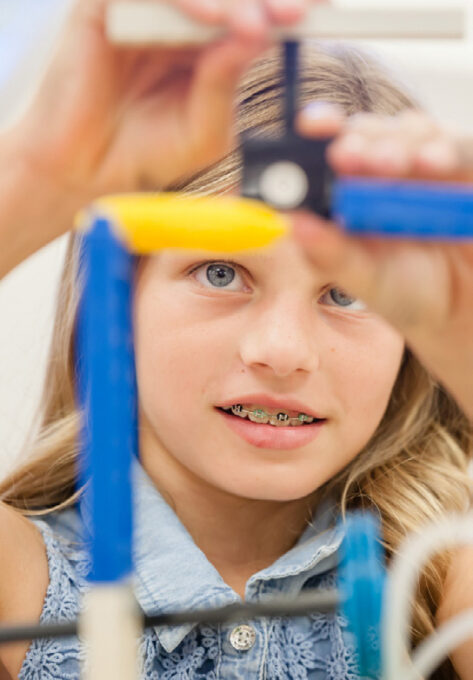
Despite the word “career” in its name, the skills students learn in CTE programs go beyond just career advancement. Programs like the architecture and construction lab at Carlsbad Unified School District’s Aviara Oaks Middle School give students a space to practice skills they’ll use throughout their lives. Students learn how to operate power tools, read plans, and properly measure to create their own projects—students have built Adirondack chairs and even tiny houses. This gives them the confidence to pursue a career in construction or make their own home repairs. Previously, the school had a wood shop that spilled onto its exterior pathways, and there was a need to provide an enclosed patio just for the wood shop. A new classroom building, designed with this construction program in mind, offers a secure patio for protecting projects in progress and allows work and learning to transition from indoors to outdoors.
These CTE spaces introduce new skills and provide real-life illustrations of the themes students learn in their daily classes. The skills students learn in CTE programs translate to all classes. What a student learns in woodshop can help them see their math homework more clearly, or what they learn in science class can help them create a tasty recipe in culinary class. As new technology and industries emerge, schools need to be flexible in the programs they offer.
EXPLORING CAREER OPTIONS AT WOODLAND PARK MS
At Woodland Park Middle School in the San Marcos Unified School District, there are multiple CTE-focused educational spaces, including a futures lab that allows students to explore a variety of potential career paths, such as cosmetology, audiovisual, and healthcare. While designing their newest classroom building, the HMC design team understood that the CTE programs would need spaces that could adapt to a range of future technologies and educational needs.
In addition to the futures lab, our preliminary designs included robotics labs, gaming centers, and other unique programs to support varying interests and academic objectives. The school also hopes to introduce a culinary program and teaching kitchens where students can gain valuable experience in a professional culinary kitchen while learning nutrition and crucial life skills. This would require more water stations and plumbing reorganization, but by designing with flexibility in mind, this space could serve current and future CTE programs and learning modalities.
ADAPTABLE CTE INFRASTRUCTURE
Two of our most significant infrastructure challenges when designing CTE spaces are access to power and data. Is there enough, and is it placed in the proper locations? So, depending on the program, we consider where and how much power to include in a space. As most districts evolve their programs, their furniture and final fixtures are growing as well. We include more mobile equipment and rely less on built-in furniture and permanent fixtures, enabling the programs to adapt quickly without altering the building’s architecture. If you’re designing one space that can support a complex program, it’s likely to lend itself to another complex program.
REAL-WORLD, ADVANCED LEARNING IN MIDDLE SCHOOLS
CTE at the middle school level is on the rise due to the increased engagement it provides students, the foundational skills it fosters, including both soft and hard skills, and the improved outcomes seen when providing early exposure to technical education, including increased graduation rates. At the middle school level, these programs are generally exploratory, allowing students exposure without undue pressure, and supporting future specialization at the high school and college levels. Designing for these programs requires a thoughtful, intentional, and flexible approach. When students are given the proper spaces, designed to support both their needs and the overall learning experience, they thrive and succeed. These are not play-sized spaces with basic technologies; they are real-world, advanced learning environments that give students a proper introduction to new skills and job training. These middle school spaces may be the first step on a student’s journey to becoming a future industry leader, opening a new world, or inspiring a new passion.